

Dental coding is how a dentist's chairside work becomes the CDT (Current Dental Terminology) codes insurers need before they'll pay. Right code, the claim pays. Wrong code, a denial shows up three weeks later with no explanation of what went wrong.
You've probably seen it happen: a D4341 denial lands on the billing desk and nobody can tell whether the problem was the code itself, a weak chart note, or a payer rule buried in a provider manual. That plays out at group practices every day, and the root cause is almost always the same: the team doesn't understand the coding system well enough to catch the error before the claim goes out.
This guide covers how the code structure actually works, what the 12 categories mean, where CDT and medical coding overlap, and the specific coding mistakes generating preventable denials heading into 2027.
TL;DR
- Dental coding means assigning ADA-maintained CDT codes to procedures so claims process correctly and practices get paid.
- CDT 2027 brings 67 changes (28 new codes, 33 revisions, 6 editorial updates) effective January 1, 2027. Implants, orofacial pain, and orthodontics see the biggest shifts.
- Coding accuracy alone does not prevent denials. Pre-claim eligibility verification catches the benefit-level mismatches that coding cannot.
What Is Dental Coding?
Dental coding is where chart notes, X-rays, and treatment plans get converted into the five-character CDT codes a payer's system can read. No code, no billable identity; the work just sits there.
- Every CDT code starts with "D" followed by four digits, organized into 12 service categories.
- The ADA's Code Maintenance Committee updates the code set annually, effective each January 1.
- CDT 2027 introduces 28 new codes, revises 33, and adds 6 editorial updates: 67 total changes.
- Certain procedures (TMJ, sleep apnea, oral surgery) require CPT and ICD-10-CM medical codes instead of CDT.
- Most denials trace to plan rules, not wrong codes: coverage, frequency and age limits, and annual maximums. On the coding side itself, the three errors that drive denials and compliance risk are upcoding, improper unbundling, and missing documentation.
A payer's adjudication engine can't process "we did a crown." It needs D2740 (porcelain or ceramic substrate) or D2750 (porcelain fused to high noble metal). Those two codes describe different crowns, and picking the wrong one means a downcode or an outright denial.
Dental Coding vs. Dental Billing
People say "coding" and "billing" like they're the same thing. They're not, and in a well-run group practice, different people handle each one.
Coding means reading the clinical documentation and picking the right CDT code. Billing means packaging a coded claim with documentation and pushing it through the clearinghouse. CDT stands for Current Dental Terminology; the ADA publishes and controls every change. All dental insurance claims in the US run on CDT codes. Medical claims use CPT, the AMA's system, and the overlap between the two is where cross-coding headaches start.
One person doing both coding and billing means mistakes in one contaminate the other. Split the roles and each step gets its own quality check.
Key Elements of Dental Coding
Four things sit behind every dental code: the CDT format, ADA governance, the 12-category structure, and an annual update cycle.
CDT codes and the ADA. Format is simple: every CDT code starts with "D" plus four digits. D0120, D2740, D4341. That first digit after the D tells you the service category: D0 is diagnostic, D1 is preventive, D2 is restorative.
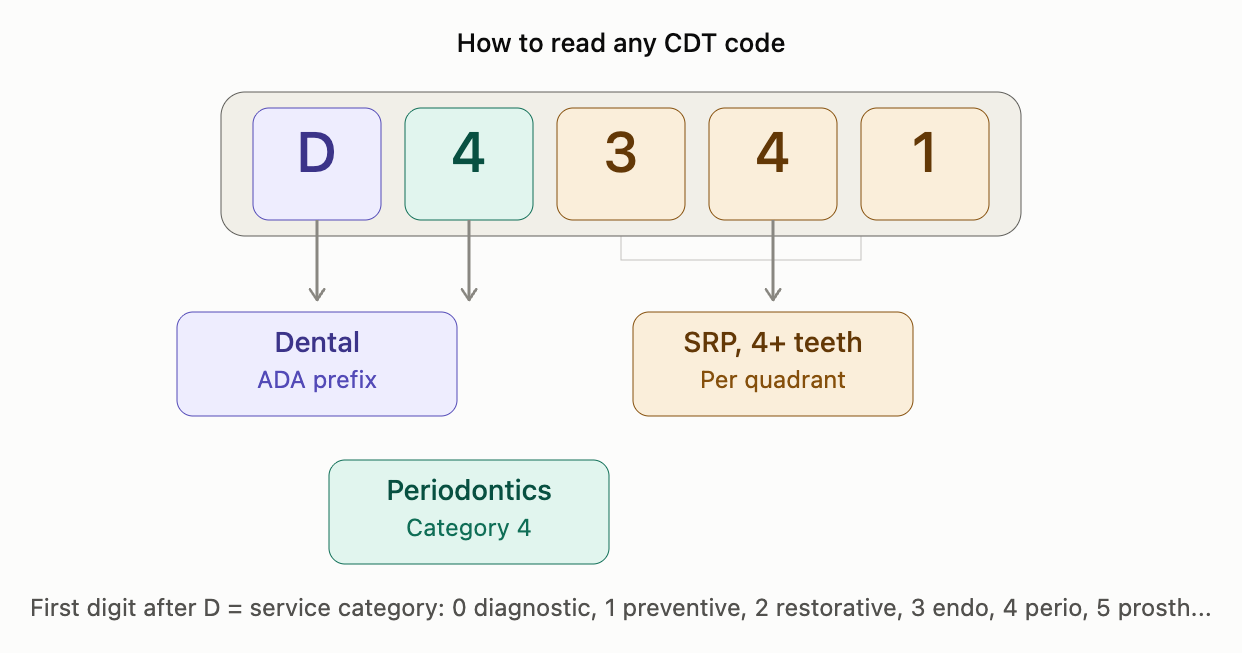
Somebody who knows this structure can place any CDT code in the right category without memorizing hundreds of descriptors. The ADA publishes the official manual every year. Nobody else gets to add, revise, or delete codes; its Code Maintenance Committee, with reps from dental associations, payers, and government agencies, reviews change requests annually and everything goes live January 1.
The 12 CDT categories of service. CDT breaks into 12 categories that map roughly, not perfectly, to the benefit tiers insurers use: preventive, basic, major. Payers reimburse at different rates by tier, which is why the category a code falls in matters.
Cross-coding with CPT and ICD-10-CM. Most dental procedures stay inside CDT, billed on the ADA dental claim form. When something overlaps with medical treatment, you may need CPT codes and ICD-10-CM diagnosis codes instead. More on that below.
The annual update cycle. The Code Maintenance Committee takes change requests all year, publishes updates each fall, effective January 1. A practice still running last year's PMS (practice management software) on January 2 is submitting to outdated codes, which auto-reject, or missing new ones that describe the work better, which causes underpayment. The 2027 update brings 67 total changes, effective January 1, 2027.
CDT Code Categories: The Complete Breakdown
| Category | Code range | What it covers | Common example |
|---|---|---|---|
| Diagnostic | D0100-D0999 | Evaluations, radiographs, diagnostic tests, pathology | D0120: periodic oral evaluation, established patient |
| Preventive | D1000-D1999 | Prophylaxis, sealants, fluoride, space maintainers | D1110: prophylaxis, adult cleaning |
| Restorative | D2000-D2999 | Fillings, crowns, inlays, onlays, veneers | D2140: amalgam, one surface |
| Endodontics | D3000-D3999 | Root canals, pulpotomies, apicoectomies | D3330: endodontic therapy, molar |
| Periodontics | D4000-D4999 | Scaling and root planing, grafts, guided tissue regeneration | D4341: SRP, four or more teeth per quadrant |
| Prosthodontics, removable | D5000-D5899 | Complete and partial dentures, relines, repairs | D5110: complete denture, maxillary |
| Maxillofacial prosthetics | D5900-D5999 | Surgical and resection prostheses, radiation carriers | D5931: obturator prosthesis, surgical |
| Implant services | D6000-D6199 | Implant placement, abutments, implant-supported restorations | D6010: surgical placement of implant body |
| Prosthodontics, fixed | D6200-D6999 | Fixed partial dentures (bridges), pontics, retainers | D6240: pontic, porcelain fused to high noble metal |
| Oral and maxillofacial surgery | D7000-D7999 | Extractions, biopsies, fracture treatment, TMJ surgery | D7140: extraction, erupted tooth |
| Orthodontics | D8000-D8999 | Comprehensive and limited orthodontic treatment | D8080: comprehensive treatment, adolescent |
| Adjunctive general services | D9000-D9999 | Anesthesia, sedation, emergency visits, occlusal guards | D9110: palliative treatment of dental pain |
Your billing team sees a smaller set of these constantly: evaluations (D0120, D0140, D0150), cleanings (D1110, D1120), radiographs (D0210, D0220, D0330), fillings (D2140 through D2394), crowns (D2740, D2750), scaling and root planing (D4341, D4342), and extractions (D7140, D7210).
Memorizing these codes is a starting point. The real test is catching errors: if the chart note describes a periodontal procedure but the code starts with D2, that mismatch should jump off the page.
Cross-Coding: When Dental Claims Need Medical Codes
Standard dental work goes on the ADA dental claim form with CDT codes. When a procedure involves a medical condition, you may need CPT codes and ICD-10-CM diagnosis codes instead, billed on a CMS-1500 to medical insurance. That's cross-coding, and most dental teams are undertrained on it.
Five situations come up over and over:
- TMJ treatment. Temporomandibular joint disorders are medical; splint therapy, arthrocentesis, and TMJ surgery are billed with CPT to medical insurance, even when a dentist does the work.
- Sleep apnea oral appliances. The appliance is dental, the condition is medical; medical insurance pays for oral appliance therapy.
- Oral pathology and biopsies. Biopsies of suspicious oral lesions are medical procedures, billed with CPT and ICD-10-CM diagnosis codes.
- Bone grafts for implants. When a medical diagnosis (trauma, pathology) drives the bone loss, some payers cover grafting as a medical condition.
- Craniofacial and trauma cases. Fracture treatment, reconstruction after trauma, and congenital deformity correction fall into medical coding territory.
Run through four questions when a procedure isn't clearly dental-only: is there a medical overlap, which insurance is primary, which claim form applies (CDT on the dental form, CPT on CMS-1500; putting a CPT code on a dental form auto-rejects the claim), and which diagnosis codes are needed (medical claims always require ICD-10-CM codes for medical necessity).
Bill a medical procedure to dental insurance and it comes back "not a covered benefit." Bill it to medical with correct CPT and ICD-10 codes and it may pay in full. TMJ, sleep apnea, and oral surgery patients in your practice who aren't being cross-coded to medical insurance represent reimbursement left on the table.
CDT 2027 Code Changes
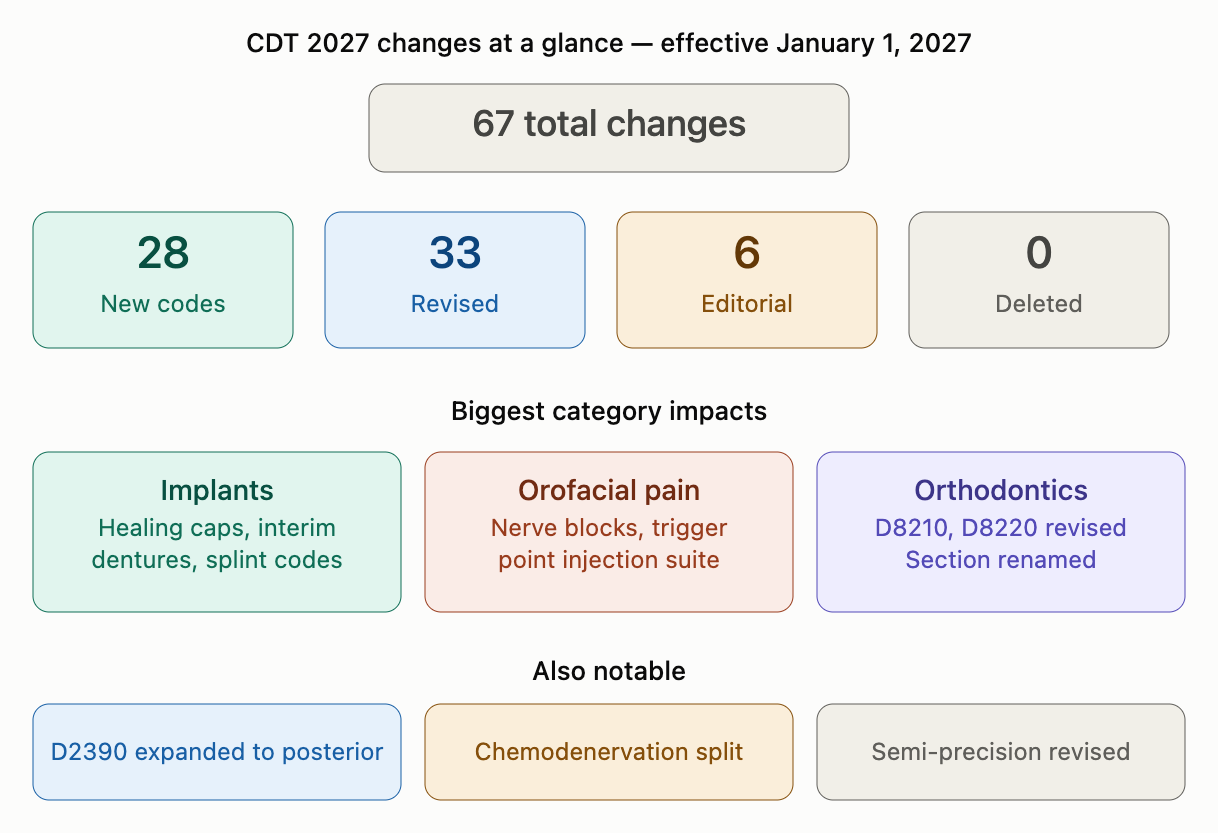
The ADA's Code Maintenance Committee approved 67 changes for CDT 2027, effective January 1, 2027: 28 new codes, 33 revised descriptors, and 6 editorial updates. No codes were deleted this cycle. Implant workflows, orofacial pain management, and orthodontics got the most attention.
| New code area | What changed | Why it matters |
|---|---|---|
| Healing cap placement | New code for placing a healing cap after implant surgery | Previously no standalone code; billed under catch-alls |
| Screw-retained restoration removal | New code for removing screw-retained indirect restorations on implants | Separates implant maintenance from surgical codes |
| Implant-retained interim fixed dentures | New codes for implant- and abutment-retained interim fixed dentures (partially edentulous arch) | Fills a gap where practices had to improvise codes |
| Fixed splint repair and removal | New codes for repairing or removing a fixed splint | Distinct from crown and bridge codes |
| Semi-precision attachments | New and revised codes separating natural-tooth placement from implant placement | Clarifies billing for combination cases |
| Orofacial pain management | New suite of nerve and trigger-point injection codes | Dedicated coding for pain management procedures |
| Chemodenervation | New codes distinguishing cosmetic from therapeutic neuromodulator use | Prevents claim confusion between medical and elective procedures |
D2390 was revised to allow use on posterior teeth, not just anterior. If your practice bills this code, check whether your PMS reflects the expanded descriptor. The orthodontic codes D8210 and D8220 were also revised, and the section header changed from "Minor Treatments to Control Harmful Habits" to "Removable and Fixed Adjunctive Orthodontic Therapy." Update fee schedules and code libraries before January 1.
Two proposals did not make the cut for 2027: local anesthesia bundling changes were deferred entirely, and the caries management treatment suite was postponed, so practices waiting for dedicated caries risk assessment codes will need to wait for CDT 2028 or later.
Where Coding Errors Actually Come From
Even good billing teams produce preventable denials from coding mistakes. Four practices address the errors that show up most often across multi-location groups.
Code what was actually performed. Upcoding, billing a more complex code than what the chart note supports, is still the number-one coding compliance violation in dentistry. Billing D7210 (surgical extraction) when no bone was removed and the chart note describes a routine extraction isn't aggressive coding; it's fraud. Match the code to the chart note. If the chart note doesn't support the code, fix the note, not the code.
Avoid improper bundling and unbundling. Some procedures are bundled by payer policy, included in another code's reimbursement, and shouldn't be billed separately. The reverse happens too: separately billable procedures get accidentally bundled because the coder assumed they were included. The only fix is payer-specific knowledge; one payer's bundling rules differ from another's, so check the provider manual when unsure.
Attach required documentation. A perfect code still denies without the right attachments. Three that trip up billing teams repeatedly: D3330 (molar root canal) often rejects without a pre-operative periapical radiograph; D4910 (periodontal maintenance) can deny as "not a covered service" without a prior D4341 or D4342 history in the system; and D7210 (surgical extraction) can downcode to D7140 without a narrative explaining why the procedure was surgical. Build attachments into the workflow rather than chasing them after the denial.
Verify eligibility before coding. This is the gap that bites even disciplined teams. Perfect code, every document attached, claim still denied, because the patient's plan hit its frequency limit last month, or the waiting period on major services hadn't lapsed, or the annual maximum was already gone. Coding accuracy and eligibility accuracy are different problems with different solutions.
Upcoding, bundling errors, missing attachments, and eligibility mismatches cause the bulk of coding-driven denials. Quarterly audits on 5 to 10% of claims catch the first three. Pre-claim verification catches the fourth.
Coding Compliance: The Legal Risk of Getting It Wrong
Coding mistakes cost more than revenue. When certain patterns repeat and look intentional, they cross into legal territory.
The False Claims Act covers practices billing government programs (Medicaid, CHIP, FEDVIP). Knowingly submitting a false claim, upcoded or fabricated codes included, carries penalties running roughly $14,400 to $28,600 per claim (inflation-adjusted, revised annually) plus treble damages. The Office of Inspector General has pursued dental practices for systematic upcoding, and pediatric dentistry with heavy Medicaid volume gets the closest scrutiny.
What draws attention: upcoding (D7210 billed when D7140 was done, D4341 for a full quadrant when only two teeth were treated), unbundling (billing components separately that belong under one code), phantom coding (billing for procedures that never happened), and provider misrepresentation (billing under a provider who wasn't in the room).
The practical defense is internal coding audits. Pull a random 5 to 10% of claims each quarter and compare the CDT code to the chart note. For DSOs, a central coding QA function handles this across locations. Either way, audits catch patterns before they become legal problems.
How Pre-Claim Verification Catches Coding-Eligibility Mismatches
Coding is half the equation. Eligibility data is the other half. A perfectly coded D4341 denies if the patient's plan won't cover periodontic services, or the frequency limit on scaling and root planing was already met for the benefit year.
That gap between the coding team's work and the payer's benefit rules is exactly where pre-claim verification fits. Before the claim gets built, a verification check confirms whether the plan covers the coded procedure, whether frequency limits allow it on the date of service, and whether the annual maximum has room for the expected amount.
Most in-house teams check active coverage but skip benefit-level detail, which is the detail that actually prevents coding-eligibility mismatches. Needletail runs the full breakdown, frequency checks and benefit maximums included, before the patient shows up. It calls carriers with AI when portal data is incomplete, and human specialists check every result before it reaches the practice. Verification won't guarantee that every claim pays, but it eliminates the eligibility-side denials that no amount of coding accuracy can prevent.
See how pre-claim verification fits into your billing workflow.