

Defining Eligibility Verification
Eligibility verification is the process of confirming a patient's insurance benefits before treatment occurs.
When you verify, you're asking the insurance company: "What are this patient's actual benefits?"
Specifically, you're looking for:
- Coverage status: Is the patient actively covered? Or did coverage lapse?
- Deductible: How much does the patient owe before insurance kicks in? How much remains?
- Annual maximum: What's the total annual benefit? How much has been used?
- Copays and coinsurance: What does the patient pay vs. what does insurance pay?
- Frequency limits: Can the patient get 2 prophys per year? Or 1? Is full-mouth X-ray limited to once per 36 months?
- Plan exclusions: Is orthodontics covered? Implants? Sleep appliances?
- Pre-authorizations: Do certain procedures (root canals, implants, major restorations) require prior approval?
When it happens: Ideally 24-48 hours before the appointment. Minimally, before treatment starts.
Who does it: Front desk, RCM coordinator, or automated system.
The outcome: A verified benefits report that shows what insurance will actually cover and what the patient owes.
Defining Billing
Billing is the process of submitting a claim to insurance after treatment, receiving payment, and managing the accounts receivable (AR).
When you bill, you're telling the insurance company: "The patient received these services. Please pay your share."
Billing includes:
- Claim submission: Formatting the treatment (CDT codes, tooth numbers, procedures) into an electronic claim and sending it to the payer.
- Payment receipt: Receiving the payer's adjudication (approval or denial) and the payment (if approved).
- Payment posting: Recording the payer's payment in your accounting system and updating the patient's balance.
- AR management: Tracking unpaid balances, sending statements, following up on denials, collecting from patients.
- Appeals and rework: If a claim is denied, you resubmit with corrections or appeal the decision.
When it happens: After treatment (usually same day or next day). Continues for weeks or months as the claim is adjudicated and payment is received.
Who does it: Billing coordinator, RCM team, practice management system.
The outcome: Payment from insurance and a reconciled patient balance.
How They Connect in the Revenue Cycle
Here's the sequence:
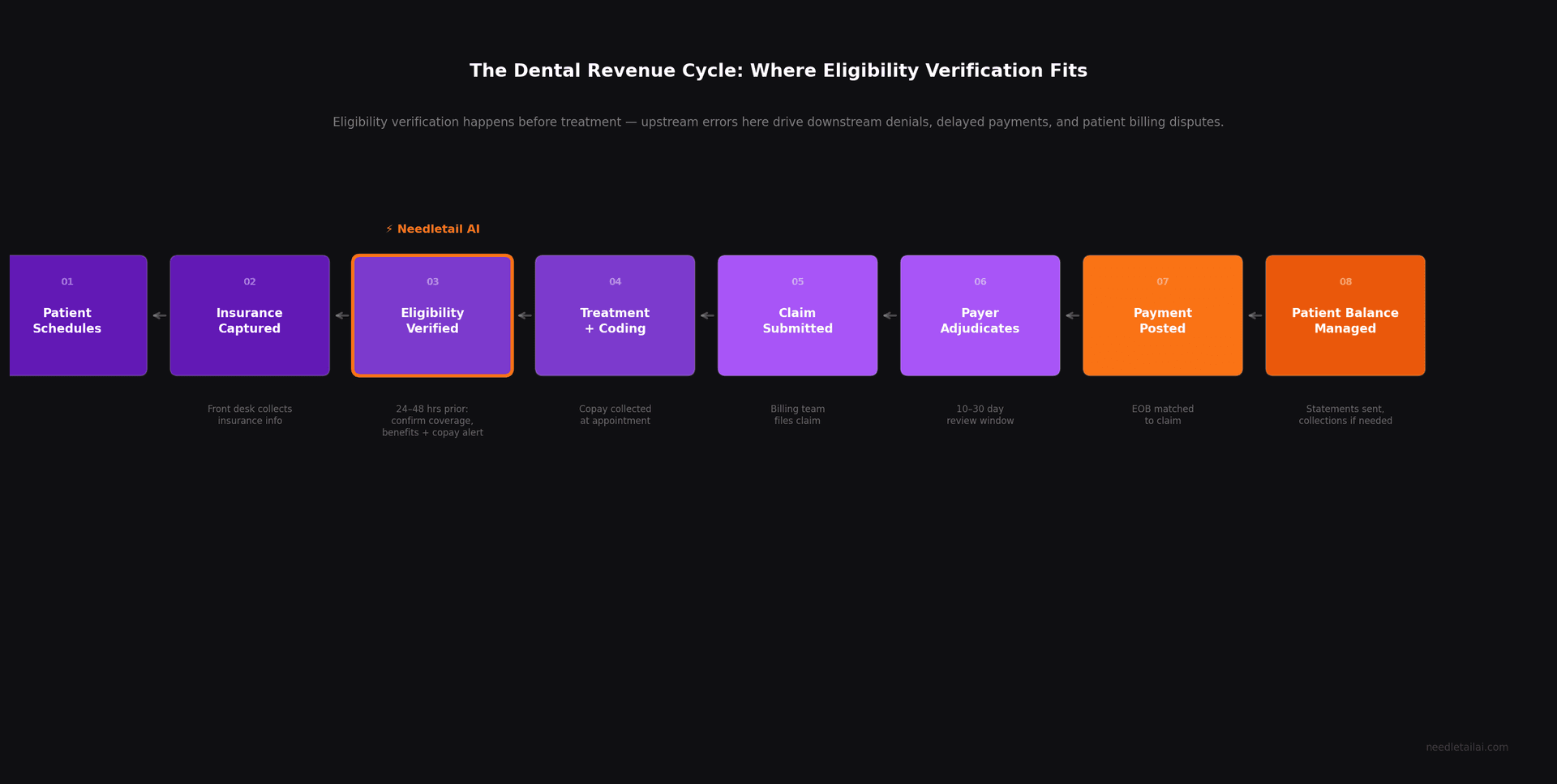
The dependency: Billing depends on eligibility. Here's why:
If you verify that deductible = $500 at step 3, you'll submit a claim at step 5 assuming the patient owes $500 of the first treatment. But if another provider saw the patient between step 3 and step 5 and submitted a claim that met the deductible, your claim assumption is wrong. Your claim gets denied or adjusted.
This is why eligibility is upstream and critical.
Why They're Often Confused
Most dental practices don't separate these two processes in their heads. They'll say "insurance verification" and mean the whole cycle from pre-visit to post-payment. This creates confusion when diagnosing problems.
Example: A practice manager says, "Our insurance verification is broken. Claims are getting denied." But what they really mean is, "Our billing process has a high denial rate." That might be:
- An eligibility problem (bad data at verification)
- A coding problem (claim coded wrong)
- A compliance problem (claim formatted wrong)
- A payer problem (payer making errors)
Without separating eligibility from billing, you can't diagnose the root cause.
Which One to Fix First: Eligibility (It's Upstream)
Here's the lever: Fix eligibility, and billing automatically improves.
Why? Because eligibility feeds billing accuracy. If you know the patient's deductible, annual max, and coverage status before treatment:
- You code correctly (you know which procedure codes will be covered)
- You submit correctly (you know what the patient owes upfront)
- Your claim is adjudicated correctly (payer sees confirmed benefits, less rework)
- Your payment is faster (clean claim = faster payment)
Conversely, if you fix billing without fixing eligibility, you're still submitting claims with bad underlying benefit assumptions. High error rate persists.
This is why most practices should prioritize eligibility over billing.
The sequence should be:
- Year 1: Fix eligibility verification (automateif possible)
- Year 2: Fix claims submission and compliance (coding, formatting, submission speed)
- Year 3: Optimize payment posting and AR management
What a Proper Dental Billing + Eligibility Stack Looks Like
A mature dental RCM operation has:
Eligibility Component:
- Real-time or 24-48 hour pre-appointment verification
- 100% payer coverage, not just the top carriers (portal AI plus voice AI handles any payer)
- Dental-specific benefit understanding (frequency limits, exclusions)
- Human QA for edge cases
- Integration with PMS (verified benefits pre-populated in charts)
Billing Component:
- Automated claim submission (rules-based, not manual)
- Real-time claim status tracking
- Denial management workflow (automatic appeals for reversible errors)
- Integrated payment posting
- AR aging reports and collection automation
When both work together:
- Eligibility catches issues before treatment
- Billing processes clean claims without rework
- AR is aged <30 days on average
- Denial rate is <5%
- Cash collection is predictable
Common Failures and Their Root Causes
"We have a 10% denial rate. What's wrong?"
Diagnose:
- Is it eligibility? (Pull 20 denied claims. If 60%+ are due to wrong coverage/deductible/exclusions, fix eligibility.)
- Is it coding? (If 60%+ are due to wrong CDT codes or bundling errors, train billing team.)
- Is it payer? (If denials come from the same 2-3 payers consistently, work with those payers directly.)
Most practices find 60-70% of denials trace to eligibility errors.
"Our AR is aging 50+ days. Why?"
Diagnose:
- Are claims taking a long time to be adjudicated? (Payer issue, not your problem.)
- Are claims being denied and re-appealed repeatedly? (Eligibility issue-bad data at submission.)
- Are claims pending for unknown reasons? (Billing follow-up issue.)
Again, most practices find that slow AR is traceable to eligibility errors that cascade into denial/rework cycles.
How Needletail Fits into the Billing + Eligibility Stack
We focus on the eligibility layer: real-time verification with 100% payer coverage, dental-specific intelligence, human QA for accuracy, direct PMS integration.
We don't do claims submission, payment posting, or AR management. That's where practice management systems (CareStack, Denticon, Open Dental) come in.
But by automating and improving eligibility, we make the entire billing stack work better. Cleaner data upstream = cleaner claims downstream.