DSO CFOs spend 80 hours a year on PPO contract negotiations and leave 60% of the available fee lift on the table. Not because they negotiated badly, because they didn't have the right data walking in.
I'll be blunt. Most DSO finance teams open PPO renewals with the same three inputs: last year's allowed amounts, a gut feeling about inflation, and whatever the payer rep emailed over. Then they argue about percentages.
Here's what the data actually says. The PPO rep already knows your claim volume, your CDT mix, your geographic distribution, and the 75th-percentile UCR in every zip code you operate in. You're negotiating from averages. They're negotiating from a heatmap.
This post is the heatmap. It's the framework we've built working with DSO CFOs who have used payer-by-payer, code-by-code, location-level reimbursement data to move contracted fees 8 to 15 percent in a single renewal cycle. The underlying concept is simple.
Fee schedules are geographic. Your leverage is geographic. Act accordingly.
What a Dental Fee Schedule Actually Is
Before any negotiation conversation, CFOs need to be precise about which fee schedule they're talking about. "Dental fee schedule by zip code" gets searched as if it were one thing. It's three things, and the type determines whether you have leverage at all.
| Fee Schedule Type | What It Is | Who Sets It | Your Leverage |
|---|---|---|---|
| UCR (Usual, Customary, and Reasonable) | Payer-calculated ceiling based on geographic market data, usually the 60th or 70th percentile of claims in a zip code | Payer (referencing external data) | Indirect: you can't negotiate UCR, but you can cite it |
| PPO Table of Allowances | Contracted per-CDT-code reimbursement rate you agreed to when you signed | Payer, negotiated with you | Direct: this is what you negotiate |
| MAC (Maximum Allowable Charge) | Fixed rate used in some indemnity and discount plans | Payer, unilaterally | Low: typically non-negotiable |
A few things CFOs consistently get wrong about these.
UCR is not published. The payer calculates it from claims data and geographic modeling, and it's usually two to three years behind current market rates. When someone says "the UCR for a crown in 90210," they're quoting an estimate from a commercial data vendor, not a public number.
PPO tables of allowances are what you actually operate against. Every claim you submit gets paid at this rate regardless of what you bill. The spread between your submitted charge and the allowed amount is the contractual adjustment that shows up on every aging report.
MAC plans are the ones to watch for in the contract language. They look like PPO plans but behave like fixed-fee plans. No negotiation, no escalator, no annual review.
When people search "fee schedule by zip code," they usually mean UCR benchmarks. Those benchmarks are the market-rate data that payers use internally to calibrate PPO contract offers. If you want to negotiate your PPO table upward, you need the UCR data the payer is already looking at.
Why Fees Vary by Zip Code (and by How Much)
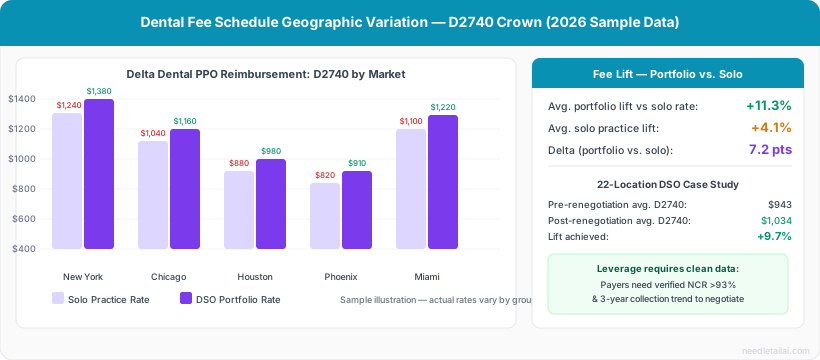
The geographic variation in dental fees is real and it's larger than most DSO finance teams assume.
In the same metropolitan area, the 90th percentile UCR for a D2740 crown can vary by $400 to $800 between a suburban, professional-heavy zip code and an urban underserved zip code five miles away. I've seen D2950 (core buildup) vary by $220 across zip codes in the same county. D7140 (extraction) by $180.
These aren't outliers. They're the normal spread.
Four factors drive the variance:
- Practice overhead. Commercial rent in the top-tier zip code might be four times the rate in the next zip over. That overhead gets priced into submitted fees and eventually into UCR data.
- Local competition density. More practices per capita push the UCR distribution down. Fewer practices push it up.
- Patient income and insurance mix. Higher-income zip codes have more submitted charges at the top of the range and fewer discount-plan claims pulling the median down.
- Payer market concentration. A geography dominated by one commercial payer has narrower UCR bands than a geography with five competing payers.
Here's the operational implication. A DSO with 18 locations across a single state is likely operating in 12 to 15 distinct fee-data geographies. A single state-wide PPO fee schedule, which is how most DSOs are contracted, is mathematically leaving money at the premium locations.
The regional average was never the right benchmark. It was a convenience.
If you're benchmarking your DSO KPIs and benchmarks at the aggregate level, you're missing the location variance. The same is true for fee data.
Where to Find Real Fee Data (Not Just the Free Tools)
The SERP for "dental fee schedule by zip code" is dominated by consumer lookup tools. Those are not negotiation data. Here's what actually works, in order of usefulness for CFO-level work.
1. FAIR Health Consumer Cost Lookup. Publicly accessible, uses aggregated claims data, gives you ballpark UCR benchmarks by zip code and CDT code. Data lag is 1 to 2 years. It's a free starting point for scoping. It's not granular enough to negotiate from.
2. ADA Health Policy Institute Survey of Dental Fees. Published every two years, CDT-code-level, regional breakdowns (Northeast, Midwest, South, West and finer geographic splits). The best publicly available source. Not zip-code level, but useful for triangulation and for citing authoritative benchmarks in negotiation letters.
3. Commercial fee data vendors. FAIR Health (the B2B product, not the consumer tool), Decision Resources, Sapphire Health, and a handful of smaller firms sell zip-code-level, CDT-code-level, percentile-banded UCR data. Pricing ranges from $2,000 to $10,000 per year depending on scope, geographic coverage, and percentile depth. This is what you need for serious negotiation. It's what the payer is already using.
4. Your own claims data. This is the most overlooked source, and it's the one CFOs almost never operationalize. What you submitted versus what each payer actually allowed, by CDT code, by payer, by location: that's your real-world contract performance. Compare it to the 75th percentile UCR from any of the three sources above, and you have a gap analysis. Gap analysis is the negotiation.
In every diligence review we've supported in the last 18 months, buyer analysts ask for payer-by-payer allowed-amount data at the location level. If it's good enough for a $300M acquisition to hinge on, it's good enough to renegotiate a $2M PPO contract around.
The CFO Negotiation Framework
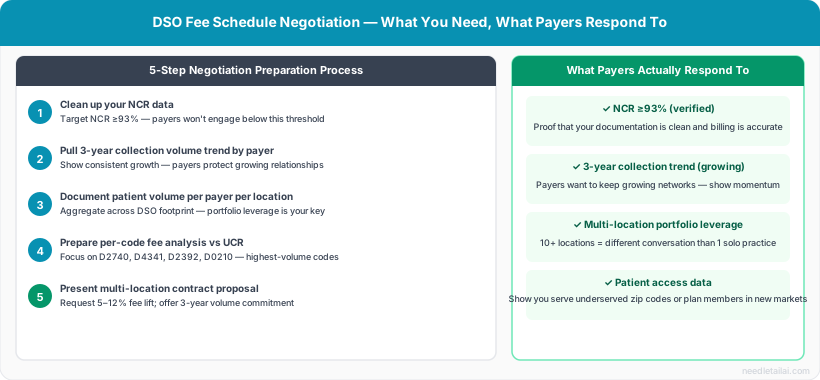
Four data points move payer contract reps. In this order.
1. Location-level reimbursement benchmarks. The opening data point. "Our D2740 allowed is $820 at this location. The 75th percentile UCR for this zip code is $1,180. We're operating 30% below market on this code at this site." The specificity is the point. A payer rep can dismiss "we think our fees are low." They cannot dismiss a named code, a named location, and a named benchmark.
2. Volume concentration. The second data point. "We're your fourth-largest participating provider group in this region. This volume: 12,400 claims last year, $4.1M in billed charges: goes to a competitor's PPO if we don't reach agreement." Contract reps have internal scorecards that weight high-volume accounts. Naming your position makes them visible.
3. New patient pipeline. The forward-looking data point. "Our new patient acquisition is up 23% year-over-year at these three locations. That's future claims volume that doesn't yet exist in your actuary's model." Payer rate models are backward-looking. Your growth is a reason to lock in favorable rates now.
4. Payer concentration strategy. The sequencing data point. Negotiate with your lowest-concentration payers first: the ones where a walk-away costs you the least revenue. Save your highest-volume payer for last. By then you have three or four successful renegotiations on record and a credible "we can shift volume" story. The payer with the most to lose should negotiate last, not first.
Most DSO finance teams do the opposite. They start with the biggest payer because it feels important. They end with the smallest because they're tired. The sequencing is backward.
Data Proof-Points That Move Payers
There's a difference between what goes in the negotiation letter and what goes on the call.
In the letter: specific, numerical, benchmark-sourced. "Across our 18 locations, our allowed amounts for the 25 highest-volume CDT codes averaged 64.2% of the 75th percentile UCR for each respective zip code. The national DSO benchmark is 78%. We are proposing an adjustment that moves our table of allowances to 72% of the 75th percentile UCR on those 25 codes." The letter is the benchmark case. It's for the rep's manager to read.
On the call: narrative, business context, future volume. "We're planning three new locations in your network region over the next 18 months. Our pipeline of DSO partnerships is pushing us toward one primary commercial carrier relationship per geography. We'd prefer that to be you." The call is where the leverage gets applied.
The framing matters. Contract reps respond to benchmark data differently than to "we want more money." One is a data presentation.
The other is a demand. Data presentations get routed to rate committees. Demands get routed to form-letter responses.
When to Renegotiate (the 3 Triggers)
DSOs leave money on the table by waiting for the annual review cycle when they should be triggering out-of-cycle renegotiations.
1. Location expansion. Every new location is a renegotiation trigger. You're bringing new volume to the panel. Most DSO PPO contracts have language allowing fee schedule amendments when participating provider count changes materially. Use it. If you just added three offices in a new MSA, that's a reason to open the conversation today, not in nine months.
2. Annual review cycle. Most PPO contracts have a 60 to 90 day renegotiation window annually. It's usually specified in the contract as "party may request fee schedule review between X and Y days before the anniversary date." Miss that window and you wait a year. Calendar it. Treat it like a board meeting.
3. Market shift. If the dominant commercial group practice in your market just raised its fees 12%, you have data to support an immediate out-of-cycle request. Market shifts are also things like a competitor leaving a network (you just became more valuable to the payer) or a payer announcing a plan change (your book of business becomes a moving target for them too).
Tracking these triggers requires the same kind of operational discipline as tracking your net collection rate or your aging bucket performance. They're CFO-calendar items, not reactive events.
PPO Opt-Out Strategy
The question no DSO CFO wants to ask out loud: at what point does staying in-network cost more than leaving it?
The math is more favorable to opt-out than most CFOs assume, especially in two scenarios.
Scenario 1: Medicaid-heavy geography with a low-reimbursement commercial PPO. If you're in a market where the dominant commercial payer is reimbursing you at 55% of the 75th percentile UCR and the patient population is already 60% Medicaid or cash, the in-network premium you're paying for access isn't large. Dropping out of that PPO and charging UCR rates to the remaining commercial patients often produces higher per-patient revenue even with 20 to 30% attrition.
Scenario 2: Discount plan saturation. If a "PPO" is really functioning as a discount plan: meaning your allowed amounts are 40 to 50% of submitted charges and patient cost-share is pushing you into effective Medicaid-like rates: you may be better off offering an in-house membership plan at comparable rates and keeping 100% of the revenue.
The calculation is straightforward. Model:
- Current revenue per year from that payer
- Projected patient retention post-opt-out (typically 60 to 80% in competitive markets)
- New allowed amount at out-of-network UCR rates
- Administrative cost savings from fewer claim denials and appeals
Last year, working with a 22-location DSO, we identified an 8.4% reimbursement gap between their Delta Dental allowed rates and the 75th-percentile UCR for their top 15 locations. The CFO's initial instinct was opt-out. The data recommended negotiate.
They negotiated, landed a 9.7% lift across the contracted codes, and the opt-out math disappeared.
The point isn't that opt-out is always right. The point is that the math should be done before every renewal, not just when the rate gets egregious.
For DSOs thinking about transaction readiness, remember that PPO fee performance also feeds directly into DSO valuation multiples. A 10% fee lift doesn't just improve EBITDA, it improves every ratio an acquirer models.
How Verification Data Strengthens Your Position
Here's the operational connection most CFOs miss.
Insurance verification data, done right, at the volume a DSO produces, is the source data for the CFO negotiation framework. Every verification record captures the plan, the payer, the contracted fee schedule, the allowed amounts by code. The quality of that data also depends on when in the workflow it's captured: DSOs running verification at T-8 (8 business days before the appointment) produce richer, more complete benefit data per record than those verifying at T-1, because T-8 allows time to resolve ambiguous benefit returns before the encounter is finalized, and complete records aggregate into cleaner fee-schedule analytics. Aggregated across thousands of patients and dozens of locations, it becomes the exact payer-by-payer, code-by-code, location-by-location reimbursement picture that commercial fee vendors charge $10,000 a year to approximate.
The difference is that your verification data is your data. It reflects your actual CDT mix, your actual patient plans, your actual payer behavior. Commercial vendor data is an average.
Your verification data is the specific underperformance. That specificity is what moves a contract rep.
Without it, you're negotiating from regional averages. With it, you're negotiating from your own book of business against market benchmarks. That's the difference between a 4% fee lift and an 11% fee lift.
The framework works because payers respond to specificity. Generic asks get generic responses. "We need a market adjustment" produces a 3% offer. "Our D2740 is 30% below the 75th percentile UCR in the five zip codes where we do 62% of our crown volume" produces a counter-offer that's already within negotiating range.
Geographic fee data is a negotiating weapon. Most DSO CFOs underutilize it because they don't know where to get the data or how to structure the ask. Both are solvable in one renewal cycle.