

A 7:45 AM Denial Report That Won't Fix Anything
It's 7:45 AM and a billing director at a 20-location DSO is pulling her denial report. Three of the top five denial reasons are coding-related. She's about to forward them to her billers with a note that reads, "Please code more carefully."
That note will not fix the problem.
In six and a half years building PMS software at CareStack, I watched this scene play out in hundreds of billing offices. The note is an understandable reaction, coding errors feel individual, so they feel like they need individual fixes. But coding denials in a DSO are almost never a competence problem. They're a structural problem: billing and coding functions fused when they should be separated, a workflow with unguarded handoff points, and the same 10 CDT codes generating most of the denials month after month.
This guide is for the director, not the coder. If you're running billing across 10, 25, or 50 locations and you want fewer coding-driven denials, here's how to structure the work.
The DSO-scale stakes: at a 20-location DSO with $20M in annual collections, coding-driven denials typically account for 2–4% of submitted claims, $400K–$800K in claims that require rework, appeal, or write-off. The 10 CDT codes that account for 62% of coding denials (documented in the section below) concentrate the majority of that risk in a fixable set of patterns. A central coding QA function that catches those 10 patterns pre-submission pays for itself within the first quarter at most groups of this size.
Dental Billing vs. Dental Coding: The Distinction That Matters
Start here, because the single most common failure mode in DSO billing operations is treating these as one job.
Dental coding is reading the clinical documentation: chart note, x-rays, treatment plan: and selecting the correct CDT code. The coder translates clinical work into billable language. Good coding requires chairside literacy: knowing the difference between a two-surface and three-surface restoration, when a D4341 (SRP, four or more teeth per quadrant) is documented versus a D4342 (one to three teeth), and when a claim needs narrative support.
Dental billing is taking the coded claim and moving it through the payer's rails to cash. The biller owns the claim form: CDT codes plus tooth numbers, surfaces, diagnosis pointers, attachments, subscriber data, COB, prior auth references. Good billing requires payer literacy: knowing that Delta PPO rejects claims without a narrative on D4910s, that MetLife wants pre-op x-rays on every crown claim, that United Concordia's portal truncates narratives over 80 characters.
These are different jobs. They attract different people. They require different training. They produce different error types.
What actually happens in a typical practice is that the front desk lead or office manager does both. She reads the chart, assigns the CDT code, fills the claim, submits it, and works the denial two weeks later. When something goes wrong, there's no way to isolate whether the failure was a coding error (wrong CDT) or a billing error (right CDT, wrong attachment). It all shows up as a denial, and the fix gets filed under "code more carefully."
The moment you separate these roles, even informally, your denial data becomes diagnostic. You can tell a coder error from a biller error, which means you can train the right gap.
For the downstream logic of how those CDT codes and insurance coverage map to payer benefit categories, that's a separate read. This guide stays on the operational side.
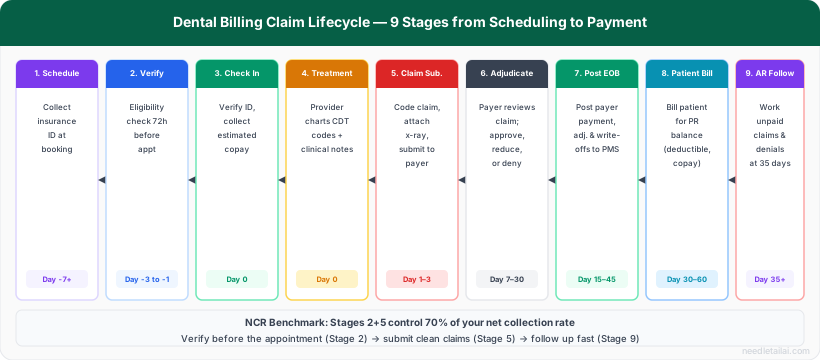
The Coding-to-Cash Workflow: 6 Handoff Points Where Errors Compound
A claim doesn't move from chair to cash in one step. It moves through six, and every handoff is a place where information gets dropped, translated incorrectly, or assumed.
Step 1: Clinical documentation. The provider completes the procedure and writes the chart note. In Open Dental, this is Progress Notes on the Chart tab. In CareStack, the Clinical Note panel on the patient dashboard. In Dentrix, the Clinical Notes section of the Patient Chart. The handoff risk here is under-documentation: the clinician charted a "crown" but didn't specify PFM vs. all-ceramic, and those map to different CDT codes (D2750 vs. D2740).
Step 2: CDT code assignment. The coder reads the documentation and assigns the code. In Open Dental, the treatment plan module auto-suggests codes based on the procedure selected at charting: and there's no mandatory QA step between that suggestion and the claim form. In Dentrix, the Treatment Planner pulls the code from the procedure code setup. The risk is twofold: the PMS's default code may not match what was actually done, and the coder may accept the default without re-reading the chart note.
Step 3: Treatment plan verification. Before the claim is built, someone should verify the codes against eligibility. Is D4341 a covered benefit today? Has the patient exceeded frequency on D1110? Is there a missing-tooth clause that will kill the D6010 implant claim? In most practices, this step is skipped. In a disciplined DSO, it's where a pre-claim scrubber flags mismatches before they become denials.
The cost of skipping this step is not theoretical. A Texas pediatric practice, running CareStack, 60 to 125 patients per day, $375,000 in monthly production, reported $200,000 in losses over four months from claims submitted against unverified eligibility data. The CDT codes were correct.
The benefit data was wrong. The owner's conclusion after cycling through three automated tools: "If we're going to double-check it, we might as well do it ourselves." Step 3 is where that $200K was either protected or lost.
Step 4: Claim generation. The biller builds the claim: codes, tooth numbers, surfaces, diagnosis pointers, attachments, narratives. In CareStack, this is the Claim Management screen. In Dentrix, it's Ledger → Insurance Claim Information. The risk is attachment and narrative completeness: the right code without the required x-ray or narrative is still a denial.
Step 5: Submission. The claim goes through the clearinghouse (Change Healthcare, DentalXChange, Waystar) to the payer. Clearinghouse rejections come back fast: missing NPIs, invalid subscriber IDs, malformed tooth numbers. These are the easy ones.
Step 6: Follow-up. The payer responds with a payment, denial, or request for additional information. This is where most billing teams spend 70% of their time: and where upstream errors finally show up. A denial caught here is already two weeks old, already a rework, already a cash-flow delay.
Most billing directors audit step 5 and step 6. The denials that get prevented come from auditing step 2 and step 3. That's the operational shift.
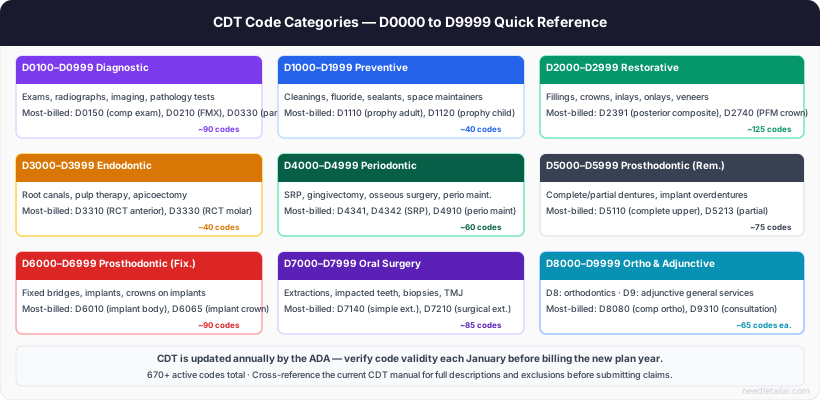
The 10 Most Miscoded CDT Codes in 2026
Across the dataset we see at Needletail, coding-driven denials cluster on the same ten codes at nearly every location. Here's what the list looks like and why each one keeps tripping coders.
| CDT Code | Description | Common Error | Why It Happens | Denial Impact |
|---|---|---|---|---|
| D0220 vs D0230 | Intraoral periapical: first film vs. each additional | D0220 billed for every PA in a series | PMS defaults every PA to D0220 | Duplicate-procedure denial on claims 2+ |
| D2740 vs D2750 | Crown, all-ceramic vs. porcelain-fused-to-high-noble | Wrong material code for the crown actually delivered | Chart note says "crown" without material | Underpayment or benefit-mismatch denial |
| D4341 vs D4342 | SRP, 4+ teeth per quadrant vs. 1–3 teeth | D4341 billed when only 2 teeth were scaled | Coder assumes "quadrant" means the whole arch | "Service not documented" denial |
| D7210 vs D7140 | Surgical vs. non-surgical extraction | D7210 billed when no bone removal occurred | Clinician called it "surgical" in the note | Downcoded to D7140 or denied |
| D2950 vs D2952 | Core buildup vs. post and core in addition to crown | D2950 billed when a post was also placed | Coder uses D2950 as the catch-all | Under-reimbursement |
| D0330 | Panoramic radiographic image | Billed within 6 months of a prior pano | Frequency limit not checked at coding | "Frequency exceeded" denial |
| D4910 | Periodontal maintenance | Billed without prior D4341/D4342 history | Patient never had active perio therapy | "Not a covered service" denial |
| D3330 | Endodontic therapy, molar | Missing pre-op PA attachment | Biller doesn't know payer requires it | "Documentation required" denial |
| D2392 vs D2393 | Resin-based composite, two vs. three surfaces | Three-surface restoration coded as two | Coder reads chart note surface count wrong | Underpayment |
| D9930 | Treatment of complications, post-surgical | Billed with no narrative | Coder omits required explanation | "Service not appropriate" denial |
The pattern across all ten: the error is systematic, predictable, and traceable to a specific gap, either the PMS default, the chart note, or the payer rule. None of this is a coder failing to try hard. This is a training and QA infrastructure problem.
Where Coding Errors Become Denials
Not every coding error becomes a denial. Understanding which ones do, and why, is how you prioritize what your QA function actually looks at.
Payer claim scrubbers run three layers of checks before a human adjudicator ever sees the claim:
Layer 1: Format and edit checks. Is the CDT code valid? Is it active for this date of service? Is the tooth number in range for this procedure? These are instant rejections and come back within hours. They're usually clearinghouse-caught, not payer-caught.
Layer 2: Policy checks. Does the member have this benefit? Is it within frequency? Is it past a waiting period? Does the age qualify? These generate auto-denials with codes like "frequency limitation exceeded," "not a covered service," or "waiting period not met." This is where D0330 and D4910 errors show up.
Layer 3: Clinical consistency checks. Does the CDT code match the diagnosis? Does the narrative support the procedure? Does the attached x-ray support the claim? These route to manual review. Denial codes here read "inconsistent with diagnosis," "service not documented," or "documentation insufficient." This is where D7210, D3330, and D9930 errors show up.
The critical insight for a billing director: layer 2 denials are preventable with pre-claim eligibility and frequency checks. Layer 3 denials are preventable with coding QA. Those are two different workflows, two different tools, and two different trainings. If you're running one scrubber and calling it "denial prevention," you're catching half the denials at best.
For the full mapping from denial reason to prevention strategy, see our claim denial prevention guide.
The Central Coding QA Function at a DSO
This is the structural argument, and it's the one I get pushback on most often: a central coding QA team that audits 10–15% of claims across all locations pays for itself, usually within the first quarter at 10+ location DSOs.
Here's the math. Across Needletail's dataset, coding-driven denials cost the average location about $14,200 per year in denied revenue and rework labor. At 20 locations, that's $284,000 annually. A central QA function, one senior coder auditing a 10% sample of claims across the group, feeding back to billers and clinical teams, typically costs $75K–$95K fully loaded. At a conservative 40% cut in coding denials, the first-year return is $113,600 in recovered revenue against a $95K cost. That's before you count the time local billers get back.
What does a central coding QA function actually do?
- Samples claims pre-submission. Typically 10–15% of claims, weighted toward high-denial-risk codes.
- Flags mismatches to the local biller before submission. Pre-claim correction, not post-denial rework.
- Aggregates patterns. If D4341 is miscoded in 12% of claims at location 7 but 2% at location 12, you know where to invest training.
- Feeds back to clinical teams. If chart notes at location 7 consistently under-document surface counts, that's a clinician conversation, not a coder conversation.
- Owns the coding playbook. A living document of DSO-specific coding decisions: defaults for borderline cases, required narratives by payer, how to document exceptions.
The function doesn't need to be huge. At 20 locations, one senior coder plus a part-time analyst is enough. At 50 locations, two plus an analyst.
The lever isn't headcount, it's concentration of judgment. One person who sees claims across the whole group spots patterns no individual biller can see from their chair.
Training New Coders: The 6-Week Framework
Onboarding a new biller-coder in a DSO is where most training gaps originate, because most onboarding is "shadow Linda for two weeks and then you're on your own." Here's a structured alternative that I've seen work across DSO groups.
Week 1: CDT structure and payer logic. Not "memorize the codes." Understand the structure: how the ten CDT categories map to the preventive/basic/major benefit categories payers use, and where the mismatches live. This is where you explain the ADA's maintenance cycle: that the CDT code set is updated annually, with the new version taking effect January 1: and why unpatched PMS versions cause problems. The ADA updated D4346 in 2017, and I saw practices running unpatched PMS versions still submitting claims under the old descriptor as recently as 2024. Week 2: High-volume codes. The 30 codes that generate 80% of claim volume for the DSO's service mix. For a general-dentistry-heavy group, that's D0120, D0140, D0150, D1110, D1120, D1206, D0210, D0220, D0274, D0330, D2140, D2150, D2160, D2161, D2330, D2331, D2332, D2335, D2391, D2392, D2393, D2394, D2740, D2750, D2950, D4341, D4342, D4910, D7140, D7210.
Week 3: Supervised coding on real claims. The new coder works through actual claims with a senior coder reviewing every decision before submission. In Dentrix, this looks like pairing on the Insurance Claim Information dialog. In Open Dental, it's pairing in the treatment plan module and the Claim Edit window.
Week 4: Denial pattern analysis. Work through the previous 90 days of denials at the new coder's home location. Categorize each by root cause: coder error, biller error, clinical documentation gap, eligibility gap. This teaches pattern recognition better than any didactic module.
Week 5: Edge cases and specialty codes. Implants, ortho, pediatric sedation, oral surgery. The codes that appear rarely but generate disproportionate denials when done wrong.
Week 6: Supervised production with QA review. The new coder is working independently, but 50% of their claims are reviewed by the central QA function. Transition to standard 10–15% QA sampling at end of week 6.
The framework is PMS-specific in execution, a Dentrix shop and an Open Dental shop run weeks 2 and 3 differently, but the structure holds. The key is that "training" isn't a week. It's six weeks, and even then the QA function is catching things for months.
Coding Audits: What, When, How
Three audit cadences, each with a different purpose.
Pre-submission audits (daily). A sample of claims reviewed before they leave the clearinghouse. Triggered by high-denial-risk codes (the ten above), by dollar threshold (e.g., any claim over $1,500), or by coder-specific error history (a new coder's first 30 days get 100% review). Goal: prevent denials.
Retrospective audits (monthly). A deeper sample: 5–10% of the prior month's claims: reviewed in aggregate to identify patterns. At 10 locations, this is roughly 300–500 claims sampled. At 50 locations, 1,500–2,500. Goal: identify training targets.
Annual comprehensive audits. A full-year lookback examining coding consistency across locations, clinician-level patterns, and year-over-year trends. Goal: strategic decisions about staffing, training investment, and PMS configuration.
The audit report itself should show, at minimum: claims reviewed, error rate, error categorization (by CDT code and error type), location breakdown, coder breakdown, and recommended training actions. Boards and operations leaders care about the top-line error rate; billing directors care about the location/coder breakdown; trainers care about the error categorization.
None of this is about catching individual coders. Every audit finding gets framed as a training or process gap. That framing matters for the culture of the function, coders will hide errors from a punitive audit and surface them to a learning audit. You want the surfacing.
For the full accountability framing on where coding errors stray into regulatory territory, illegal dental billing practices covers the line between error and fraud.
Automation in Coding QA
Here's where I want to be careful, because the market narrative around AI in coding is often "AI replaces coders." That's not what the technology is good at today, and it's not the right operational framing for a billing director.
What automation does well in coding QA:
Cross-referencing CDT codes against eligibility data. Is this code covered on this patient's plan? Frequency limit? Waiting period? Missing-tooth clause? This is layer-2 prevention, and it's where eligibility-verification automation earns its keep.
Flagging high-denial-risk codes for human review. Every claim containing one of the ten codes above gets auto-flagged for QA sampling. The coder keeps their judgment; automation routes the claim to the right reviewer.
Detecting systematic patterns. One coder's D4341-vs-D4342 confusion looks like a training gap. Five coders across three locations showing the same confusion looks like a PMS configuration issue or a chart-note template problem. Automation sees the cross-location pattern faster than a human.
Narrative completeness checks. Did the D9930 claim include a narrative? Is it longer than the payer's 80-character minimum? Does the D3330 have a pre-op PA attachment? These are mechanical checks automation catches with near-perfect precision.
What I wouldn't delegate to it: reading a chart note and deciding what was actually done. Whether the crown was PFM or all-ceramic, whether the extraction required bone removal, whether the filling touched two surfaces or three, those decisions still belong with a human coder. AI-suggested codes are useful as a first pass. They are not the final answer.
The right mental model: automation isn't replacing the coder. It's catching the errors the coder makes at handoff point 3, the pre-claim eligibility and consistency layer, before a claim ever gets submitted.